UC Chile study links urban development, beach loss, and rising sea swell intensity
Excessive urbanization, according to the UC Chile Coastal Observatory Center, is erasing beaches and coastal ecosystems—nature’s first line of defense against intensifying sea swells fueled by climate change.
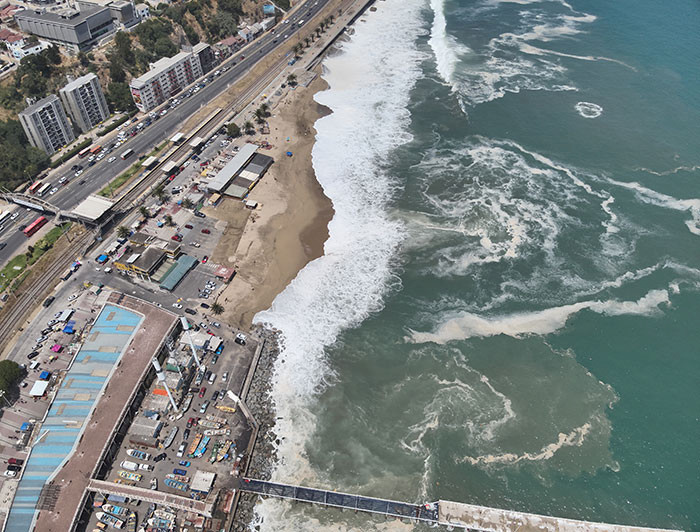
photo_camera Waves reaching up to 11 meters are accelerating coastal erosion along Chile’s coast. Research shows 86% of beaches between Arica and Puerto Montt are shrinking. (Photo: Sea swells in Valparaíso and Viña del Mar, courtesy of the UC Coastal Observatory Center)
Recent sea swells have caused substantial morphological changes and severe impacts along Chile's coastline. Known for their intensity, these swells resulted in fatalities and significant damage to coastal infrastructure in municipalities such as Algarrobo, Concón, and Valparaíso.
This event is among the most significant of its kind since 2015—a year when swells began to grow increasingly intense and persistent along Chilean coasts. The UC Chile Coastal Observatory Center highlights that while there is a link between this phenomenon and climate change, the underlying issue lies in how we occupy and use coastal areas.
Carolina Martínez, Director of the UC Chile Coastal Observatory Center and professor at the Institute of Geography, points out that although this phenomenon was not considered a significant concern until just over a decade ago, Chile’s coastline now experiences an average of 45 sea swells each year.
“The swells hitting much of our country’s coastline show just how big a problem this is—one we’re not prepared for and that involves a lot of complex factors,” Martínez explains.
Vanishing Beaches, Rising Risks
Sea swells—producing waves as high as 11 meters—are a primary driver of coastal erosion. Studies conducted by the Center show that 86% of beaches between Arica and Puerto Montt are retreating, with erosion rates doubling annually in some of Chile’s most popular coastal tourist destinations.
Research on 66 beaches from Arica to Chiloé, published in the book Towards a Coastal Law in Chile: Foundations for Integrated Coastal Zone Management (Fondecyt Project No. 1200306, GeoLibro series), suggests erosion rates range from -0.2 to over -1.5 meters per year. In extreme cases—such as Algarrobo and Santo Domingo in central Chile, and Hornitos in the north—erosion exceeds five meters annually.
This was one of the first studies to demonstrate a direct link between sea swells and beach erosion in Chile, revealing that urban beaches can disappear overnight. One notable example is Playa La Boca in Concón, which eroded during the first weekend of 2025.
However, a key factor that heightens the risk and amplifies the impact of swells on beaches is excessive urbanization, which has steadily increased in recent decades, the researcher adds.
Globally, 60% of the population lives within 60 kilometers of a coastline—a pattern mirrored in Chile. This trend, Martínez notes, increases exposure to extreme events, which are now intensified by climate change and are expected to remain frequent in the coming decades.
Beaches, river mouths, wetlands, and dunes are interconnected ecosystems that serve as natural defenses against extreme events such as sea swells and tsunamis. Yet, despite their protective role, these ecosystems are degrading rapidly—leaving the coast increasingly vulnerable.
“Today, beaches struggle to recover seasonally as they once did. In the past, sand displaced by winter storms would return in summer. Now, due to urbanization and the disruption of rivers and ravines, sediment is no longer replenishing the beaches. This is a fundamental issue that has received insufficient attention.”
Classifying the Sea’s Force: Toward a Sea Swell Typology
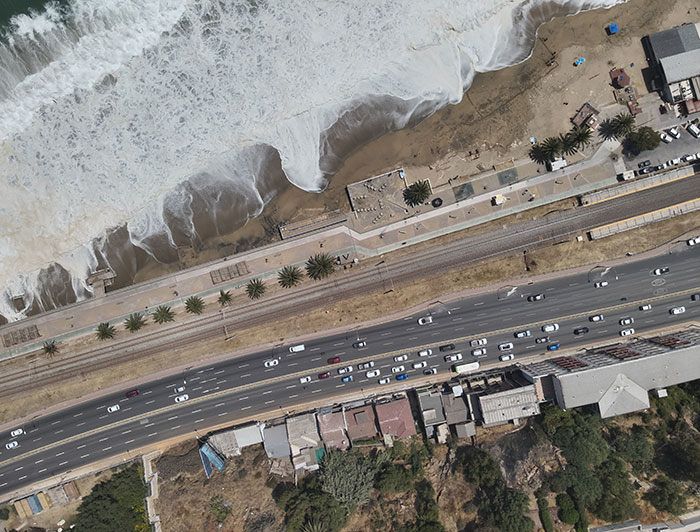
One key strategy for minimizing damage—especially as Chile’s coasts now require rebuilding approximately every two years due to recurring threats—is the development of a sea swell typology. This tool could improve the ability to predict and prepare for extreme events like those witnessed in late 2024 and early 2025.
“Due to the geographical characteristics of Chile’s coasts, with many bays facing north, coastal storms from the northern Pacific tend to have the most severe impact. The recent swell is a clear example of this.”
“We are studying typologies to identify extreme sea swell scenarios, similar to how tsunamis are categorized,” explains Martínez.
A Legal Framework for the Coastline: The Case for a Coastal Law
Martínez advocates for nature-based solutions and community involvement through citizen science as effective ways to mitigate these impacts.
Ecological restoration of degraded ecosystems—such as kelp forests—could also play a significant role by reducing the energy of extreme swells. However, illegal exploitation of these resources persists, often with minimal regulation or oversight.
Martínez stresses the urgent need for Chile to implement a Coastal Law to regulate activities along the coast, including construction permits, maritime concessions, and the extraction of materials like sand and gravel, which affect both beaches and rivers.
The UC Chile Coastal Observatory Center proposed a Coastal Law initiative in 2022, based on nine principles of sustainable development. Despite its presentation to the Ministry of National Assets, it has yet to receive consideration from the government.
“We need specific regulations for coastal areas to address these threats and preserve the valuable ecosystem services they provide. Chile has waited over a century for such a law, while other OECD countries have already implemented sustainable coastal management policies. Without action, the legal void will continue to pass the consequences of poor coastal governance onto society and future generations,” concluded Director Martínez.


